
Welcome to Part 2 of “How to Write an Excellent Email Subject Line,” where I’ll share more strategies for writing subject lines that boost open rates and drive engagement. Click here to read Part 1.
Experiment with Different Strategies
Every audience is different, so it’s worth trying out multiple approaches to see which resonates. In my time as a promotional email copywriter, I’ve found it helpful to experiment with both subject lines that tell you what to expect and those which leave the message more of a mystery.
Here’s an example of a subject line that gets straight to the point:

It doesn’t get more clear than this: SNAP Custom Pizza is offering a $5 discount on pickup orders. If the recipient is interested, she’ll open the email; if not, she won’t.
Another strategy is to write a subject line that hints at the contents of an email without giving it away. For instance, take a look at this subject line from Lulus (an online clothing and accessories boutique):

Lulus sent this email on February 14, so the subject line references Valentine’s Day while simultaneously teasing content. What’s really clever about this subject line is that it could be referring to just about anything: a sale, a special offer, or new arrivals on the site, to name a few possibilities. (It was an offer code for 30% off winter essentials). Some customers will open an email with this type of subject line out of curiosity, while others may ignore it. Try both strategies to see what works for your subscriber base. You may even consider alternating between the two when you notice open rates start to drop.
Maintain a Consistent Brand Voice
Every company has its own unique voice. While most strive to strike a tone that’s friendly and conversational, some are more informal than others, and some (particularly those with a more high-end image) even use diction with the goal of appearing “proper” or “distinguished.” A great example of the latter is Charles Tyrwhitt, a British men’s clothing company which specializes in dress shirts, trousers, and other formal attire. A shipping notification from them reads as follows:
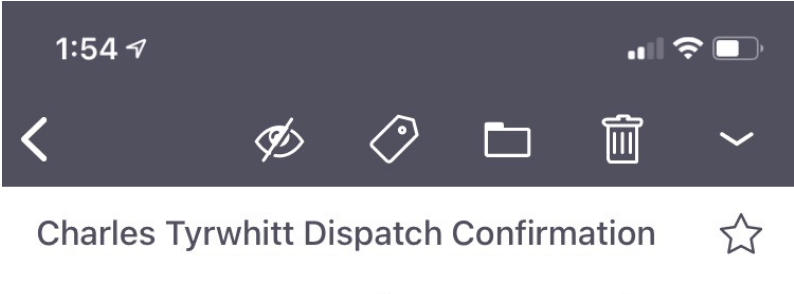
While most other retailers would use much simpler, more informal language, such as “Your Shipping Confirmation” or even “Hooray! Your Order’s on Its Way,” Charles Tyrwhitt uses the word “dispatch.” This choice of diction is true to the company’s voice.
On the other end of the spectrum, Yoga with Adriene, an online community led by yoga teacher Adriene Mishler, aims for a warm, loving tone in all of its communications. This subject line is a good example:

Adriene’s emails to her subscriber base reinforce the positive energy that she radiates in every video. She maintains an authentic brand voice by making frequent references to acts of love, “finding what feels good,” and finding beauty in yoga practice and even refers to her weekly emails as “love letters.”
Reference the Day or Time
At the start of a typical conversation, you probably make some reference to the day or time, perhaps by saying, “Good morning,” “How was your day,” or “How was your weekend?” By the same token, making reference to the time or day of the week in the subject line of an email can serve as an icebreaker, striking a conversational tone with your subscriber base. Here’s an example from QVC:

The body of this email features deals on various products, including a handbag, a hair scrub and an indoor grill. Since the deals don’t all fit neatly into one category, referencing the fact that the email will be sent on Friday is a great way to get the customer’s attention. It also offers her a built-in excuse to click through and fill her online cart, even if she wasn’t planning to shop that day: who couldn’t use a pick-me-up?
Please don’t hesitate to reach out if you decide to try out any of these strategies, and stay tuned for my next post on a new topic!

 Julia Anderson